If two equal chords of a circle intersect within the circle, prove that the segments of one chord are equal to the corresponding segments of the other chord.

| AM | = | MB =  AB (Perpendicular
bisecting the chord) AB (Perpendicular
bisecting the chord) |
| CN | = | ND = CD (Perpendicular
bisecting the chord) |
| AM | = | ND and MB = CN (As AB = CD) |
| In triangle OMP and ONP, we have, | ||
| OM | = | MN (Equal chords are equidistant from the centre) |
| ∠OMP | = | ∠ONP (90°) |
| OP is common. Thus triangle OMP and ONP are congruent (RHS). | ||
| MP | = | PN (cpct) |
| So, AM + MP | = | ND + PN |
| or, AP | = | PD .......... (i) |
| As MB | = | CN and MP = PN, |
| MB - MP | = | CN - PN |
| PB | = | CP ....... (ii) |
If two equal chords of a circle intersect within a circle, prove that the line joining the point of intersection to the centre makes equal angles with the chords.
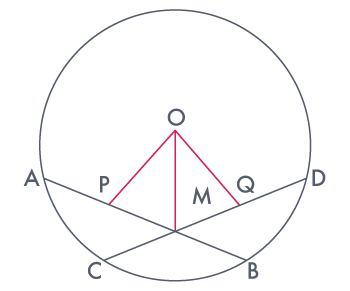
| ∠OPM | = | ∠OQM |
| OM | = | OM {common} |
|
By SAS congruence criterion,
|
||
| ΔOPM | ≅ | ΔOQM |
| So, ∠OMA | = | ∠OMD |
| or ∠OMP | = | ∠OMQ {by CPCT} |
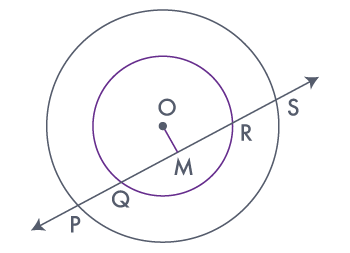
If a line intersects two concentric circles (circles with the same centre) with centre O at P, Q, R and S, prove that PQ = RS
Two circles of radii 17 cm and 25 cm intersect at two points and the distance between their centres is 28 cm. Find the length of the common chord.
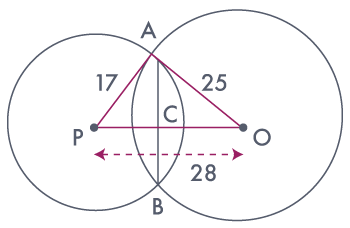
| In ΔACP, | ||
| AP2 | = | AC2 + PC2 |
| (17)2 | = | AC2 + x2 |
| AC2 | = | (17)2 – x2 ..... (i) |
| In ΔACO, | ||
| AO2 | = | AC2 + CO2 |
| (25)2 | = | AC2 + (28 – x)2 |
| AC2 | = | (25)2 – (28 – x) |
| = | 625 – (784 + x2 – 56x) | |
| = | – 159 – x2 + 56x ..... (ii) | |
| From (i) and (ii) | ||
| (17)2 – x2 | = | – 159 – x2 + 56x |
| 56x | = | 448 |
| x | = | 8 |
| From eq (i) | ||
| AC2 | = | 172 – 82 |
| AC | = | 15 |
| From the figure, OP ⊥ AB | ||
| AC | = | CB |
| AB | = | AC + CB |
| = | 2AC = 30 | |
Three girls Roja, Shanthi and Madhu are playing a game by standing on a circle of radius 4 m drawn in a park. Roja throws a ball to Shanthi, Shanthi to Madhu, Madhu to Roja. If the distance between Roja and Shanthi and between Shanthi and Madhu is 4 m each, what is the distance Roja and Madhu?
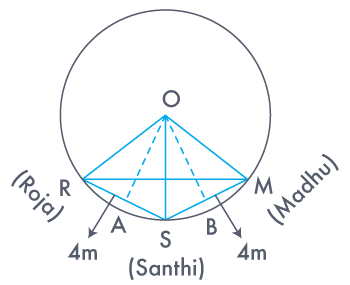 × OA × RS × RC
× OS = × 2√3 × 4
× OA × RS × RC
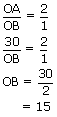
× OS = × 2√3 × 4A circular park of radius 30 m is situated in a colony. Three boys Arun, Sham and Dev are sitting at equal distance on its boundary each having a toy telephone in his hands to talk each other. Find the length of the string of each phone.
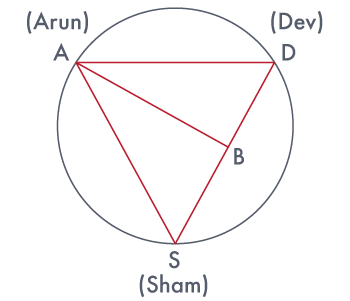
Of any two chords of a circle, show that the one which is large is nearer to the centre.
Construction join OA and OC
 AB
ABand CF =
CD ------- (i)
CD < AB
⇒ CF < AE ------ (iii) [from (i)]| OA2 | = | OE2 + AE2 and |
| OC2 | = | OF2 + CF2 |
| ⇒ OE2 + AE2 | = | OF2 + CF2 [∵ OA = OC ⇒ OA2 = OC2] |
| ⇒ OE2 + AE2 | < | OF2 + AE2 [using (iii)] |
| ⇒ OE2 | < | OF2 |
| ⇒ OE | < | OF |